

English
What Makes the Export of DG Cargos So Challenging?
Published: 2026-02-11Author: Transforce Chemical Logistics

"This batch of DG cargos is stuck at customs again!" This is an exclamation often heard from many fellow freight forwarders.

As freight forwarders, we fully understand that the complexity of exporting DG cargos is far greater than that of ordinary goods.

What exactly makes the export of DG cargos so difficult? Today we will take an in-depth look at this issue.

01

Stringent Regulations and Multiple Standards

The primary challenge in exporting DG cargos is the complex international and domestic regulations. From the United Nations' Recommendations on the Transport of DG cargos to the International Maritime Organization (IMO)'s International Maritime DG cargos (IMDG) Code, and then to the domestic regulations of various countries, they form a vast and complex regulatory system.

Take lithium batteries as an example. This common type of DG cargos needs to meet the UN 38.3 test requirements, special provisions of the IMDG Code, and also comply with the specific requirements of the country of transport and the destination country. Different countries and even different ports may have different standards for the same type of DG cargos, which further increases the difficulty of compliance.

02

Professional Classification and Packaging Requirements

DG cargos are not a single concept. The United Nations classifies them into 9 categories, including explosives, gases, flammable liquids, flammable solids, etc., and each category has detailed subdivisions. Accurate classification is the first and crucial step in export.

Packaging requirements are equally stringent. DG cargos must use certified packaging containers, which need regular inspection and maintenance. There are specific regulations on packaging methods, filling materials, sealing performance, etc. Any negligence in details may lead to the rejection of the entire batch of goods.

03

Complex Documentation and Labeling System

The transportation documents for DG cargos can be called a "mountain of paper", including but not limited to:

· Booking Note (showing "Shipper, Consignee, Notify Party, Description, Gross Weight, Measurement")

· DG cargos Declaration Form

· Safety Data Sheet (SDS/MSDS)

· Packaging Performance Inspection Certificate

· Transportation Appraisal Report

Labels and marks are also crucial. Correct DG cargos labels, transportation labels, and handling labels must be clearly pasted on the packaging. There are detailed regulations on the size, color, position, and content of the labels. A single error in a label may result in the detention of goods.

04

Limited Transportation Resources and High Costs

The transportation of DG cargos requires special resources, and these resources are often limited:

· Special containers and ships: Many shipping companies only allocate part of their ships to carry DG cargos

· Special warehousing facilities: DG cargos warehouses must comply with strict safety standards

· Professional personnel: The handling of DG cargos requires specially trained personnel

These limitations result in significantly higher transportation costs for DG cargos compared to ordinary goods, and cargo space is also more tight. Especially during peak seasons, DG cargos often face a situation where "one cabin is hard to find".

05

Port and Route Restrictions

Not all ports can handle DG cargos, and different ports have different restrictions on the types and quantities of DG cargos.

For example, some ports may completely prohibit certain categories of DG cargos, while others only allow a specific quantity of DG cargos to pass through.

Route selection is also restricted. Certain sea areas or canals have special regulations on the transportation of DG cargos, which may require detours or additional safety measures.

06

Tedious Inspection and Approval Processes
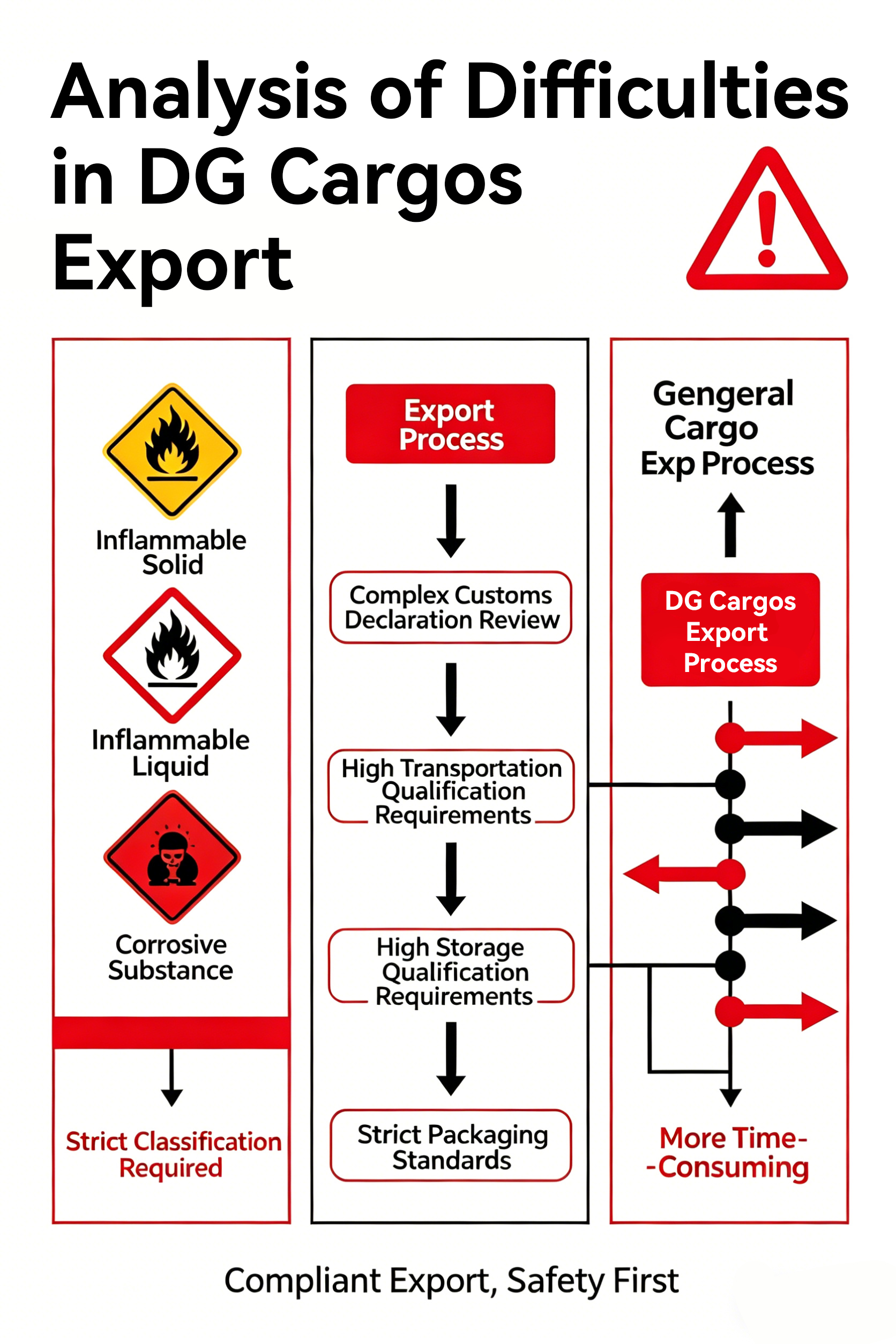
The inspection rate for exported DG cargos is usually higher than that of ordinary goods. Customs, maritime departments and other multiple agencies may conduct joint inspections on DG cargos, with complex and time-consuming processes.

In addition, many DG cargos also require advance approval. In some cases, shippers need to apply for transportation permits weeks in advance, which greatly prolongs the entire export process.

07

Liability Risks and Insurance Challenges

The liability risks of DG cargos transportation are far higher than those of ordinary goods. Once an accident occurs, the consequences can be very serious. Therefore, all relevant parties (shippers, freight forwarders, carriers) have to bear greater responsibilities.

In terms of insurance, the insurance premium rate for DG cargos is usually higher, and some insurance companies may refuse to provide insurance for certain high-risk DG cargos, which increases the difficulty of overall risk management.

08

Technology Updates and Knowledge Requirements

Regulations and technical requirements for DG cargos are constantly updated. Taking lithium battery transportation as an example, the relevant regulations have been adjusted almost every year in recent years.

Freight forwarders and shippers must continue to learn and timely master the latest requirements, which puts forward high demands on professional capabilities.


Solutions and Response Strategies


1. Establish a professional team: Equip with experienced DG cargos operation specialists

2. Continuous training: Regularly update the professional knowledge of the team

3. Strict review: Establish a multi-level review mechanism to ensure compliance in every link

4. Advance planning: Reserve sufficient time for DG cargos transportation

5. Establish an emergency mechanism: Formulate contingency plans for unexpected situations


Although exporting DG cargos is full of difficulties, it can still be completed smoothly with professional knowledge, careful preparation and strict operation.

As freight forwarders, we are both guardians of compliance and fulfillers of customer needs. Finding a balance between these two is the embodiment of our professional value.

If you have a demand for exporting DG cargos, it is recommended to start preparation at least 4-6 weeks in advance and cooperate with a professional DG cargos freight forwarding team to ensure that your goods reach the destination safely, in compliance with regulations and on time.

After all, in the field of DG cargos transportation, "safety first" is always the unchanging golden rule.

*Part of the content is sourced from the Internet

Copyright © 2026 Transforce Chemical Logistics Shanghai Co.,Ltd.  All rights reserved